This article is part of the ultimate guide to language for teachers and students. Click the buttons below to view these.
A TEACHER’S GUIDE TO SENTENCE STRUCTURE
If you are grading middle school writing right now, you are probably seeing the same two extremes: endless, breathless run-on sentences, or choppy, three-word fragments. Getting students to master independent and dependent clauses is one of the hardest hurdles in teaching writing. In this guide, we break down exactly how to teach simple, compound, and complex sentences so they actually stick.
This article aims to inform teachers and students about writing great sentences for all text types and genres. I would also recommend reading our complete guide to writing a great paragraph here. Both articles will find great advice, teaching ideas, and resources.
WHAT IS SENTENCE STRUCTURE?
When we talk about ‘sentence structure’, we are discussing the various elements of a sentence and how these elements are organized on the page to convey the desired effect of the author.
Writing well in terms of sentence structure requires our students to become familiar with various elements of grammar and the various types of sentences that exist in English.
In this article, we will explore these areas and discuss various ideas and activities you can use in the classroom to help your students on the road to mastering these different sentence structures. This will help make their writing more precise and interesting in the process.
TYPES OF SENTENCE STRUCTURE
In English, students need to get their heads around four types of sentences. They are:
Mastering these four types of sentences will enable students to articulate themselves effectively and with personality and style.
Achieving this necessarily takes plenty of practice, but the process begins with ensuring that each student has a firm grasp on how each type of sentence structure works.
But, before we examine these different types of structures, we must ensure our students understand the difference between independent and dependent clauses. Understanding clauses and how they work will make it much easier for students to grasp the following types of sentences.
SENTENCE CLAUSES
Teaching sentence clauses requires a deep understanding of the topic and an ability to explain it in an engaging and easy way for students to understand. In this article, we’ll discuss the basics of sentence clauses and provide some tips for teaching them to students.
What are Sentence Clauses?
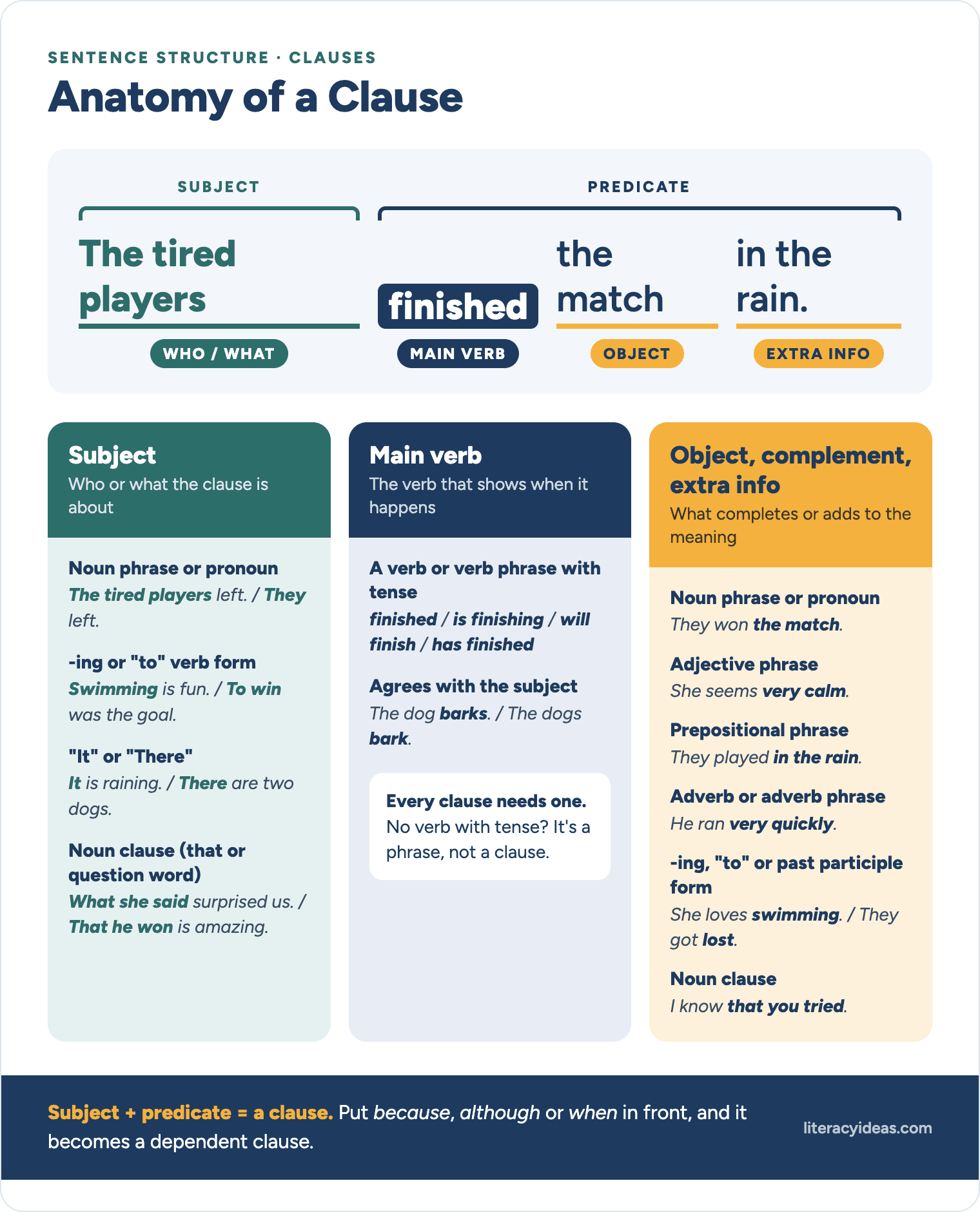
A sentence clause is a group of words that contains a subject and a verb. It can be a complete sentence on its own or a part of a larger sentence. There are two types of sentence clauses: independent and dependent.
Independent Clauses
Put simply; clauses are parts of a sentence containing a verb. An independent clause can stand by itself as a complete sentence. It expresses a complete thought or idea and includes a subject and a verb – more on this shortly!
Here’s an example of an independent clause in a sentence:
“I went to the store.”
In this sentence, “I went to the store” is an independent clause because it can stand alone as a complete sentence and expresses a complete thought. It has a subject (“I”) and a verb (“went”), and it can be punctuated with a period.
Dependent Clauses / Subordinate Clauses
Dependent clauses, on the other hand, are not complete sentences and cannot stand by themselves. They do not express a complete idea. To become complete, they must be attached to an independent clause. Dependent clauses are also known as subordinate clauses.
An excellent way to illustrate the difference between the two is by providing an example that contains both.
For example:
Even though I am tired, I am going to work tonight.
In this sentence, Even though I am tired is the dependent clause. It has a subject (I) and a verb (am), but it can’t stand alone; on its own it leaves the reader waiting for the rest. I am going to work tonight is the independent clause, because it makes complete sense by itself.
Teaching sentence clauses to students is essential because it helps them understand sentence structure. Understanding the structure of sentences is essential for effective writing and communication. It also helps students to identify and correct common errors in their writing, such as sentence fragments and run-on sentences.
The action itself will be encapsulated by the verb, which is the action word that describes what the doer does.


Simple Sentences
Simple sentences are, unsurprisingly, the easiest type of sentence for students to grasp and construct for themselves. Often these types of sentences will be the first sentences that children write by themselves, following the well-known Subject – Verb – Object or SVO pattern.
The subject of the sentence will be the noun that begins the sentence. This may be a person, place, or thing, but most importantly, it is the doer of the action in the sentence.
The object of the sentence follows the verb and describes that which receives the action.
This is again best illustrated by an example. Take a look at the simple sentence below:
Tom ate many cookies.
In this easy example, the doer of the action is Tom, the action is ate, and the receiver of the action is the many cookies.
Therefore,
Subject = Tom
Verb = ate
Object = many cookies
After some practice, students will become adept at recognizing SVO sentences and forming their own. It’s also important to point out that simple sentences don’t necessarily have to be short.
For example:
This new research on healthy habits reveals the powerful effect of an active lifestyle on the life expectancy of the average person.
Despite this sentence looking more sophisticated (and longer!), this is still a simple sentence as it follows the SVO structure:
Subject = research
Verb = reveals
Object = the powerful effect of an active lifestyle on the life expectancy of the average person.
Though basic in construction, it is essential to note that a simple sentence is often the perfect structure for dealing with complex ideas. Simple sentences can effectively provide clarity and efficiency of expression, breaking down complex concepts into manageable chunks.
MORE SIMPLE SENTENCE EXAMPLES
- She ran to the store.
- The sun is shining.
- He likes to read books.
- The cat is sleeping.
- I am happy.
Simple Sentence Reinforcement Activity
To ensure your students grasp the simple sentence structure, have them read a photocopied text pitched at a language level suited to their age and ability.
On the first run-through, have students identify and highlight simple sentences in the text. Then, students should use various colors of pens to pick out and underline the subject, the verb, and the object in each sentence.
This activity helps ensure a clear understanding of how this structure works and helps to internalize it. This will reap rich rewards for students when they come to the next stage, and it’s time for them to write their own sentences using this basic pattern.
After students have mastered combining subjects, verbs, and objects into both long and short sentences, they will be ready to move on to the other three types of sentences, the next of which is the compound sentence.
EXAMPLES OF SIMPLE, COMPLEX AND COMPOUND SENTENCES
| SIMPLE | COMPLEX | COMPOUND |
| Being tired, he went to be. | As he was tired, he went to bed. | He was tired. He went to bed. |
| Having finished his work, he returned home. | After he had finished his work, he returned home. | He had finished his work. He returned home. |
| I saw a girl with blue eyes. | I saw a girl who had blue eyes. | I saw a girl. She had blue eyes. |
COMPOUND SENTENCES
While simple sentences consist of one clause with a subject and a verb, compound sentences combine at least two independent clauses that are joined together with a coordinating conjunction.
There’s a helpful acronym to help students remember these coordinating conjunctions; FANBOYS.


Some conjunctions will be more frequently used than others, with the most commonly used being and, but, or, and so.
Whichever of the conjunctions the student chooses, it will connect the two halves of the compound sentence – each of which could stand alone as a complete sentence.
Compound sentences are an essential way of bringing variety and rhythm to a piece of writing. The decision to join two sentences together into one longer compound sentence is made because there is a strong relationship between the two. Still, it is important to remind students that they need not necessarily be joined as they can remain as separate sentences.
The decision to join or not is often a stylistic one.
For example, the two simple sentences:
1. She ran to the school.
2. The school was closed.
It can be easily joined together with a coordinating conjunction that reveals an essential relationship between the two:
She ran to the school, but the school was closed.
As a bonus, while working on compound sentences, a convenient opportunity arises to introduce the correct usage of the semicolon. Often, where two clauses are joined with a conjunction, that conjunction can be replaced with a semicolon when the two parts of the sentence are related, for example:
She ran to the school; the school was closed.
While you may not wish to muddy the waters by introducing the semicolon while dealing with compound sentences, more advanced students may benefit from making the link here.
MORE COMPOUND SENTENCE EXAMPLES
- I want to go to the beach this weekend, but I also need to finish my homework.
- She loves to sing and dance, so she decided to audition for the school musical.
- I enjoy reading books, and my brother prefers to watch movies.
- The dog barked at the mailman, and the mailman quickly walked away.
- He ate his breakfast, and then he went for a run in the park.
Reinforcement Activity:

A good way for students to practice forming compound sentences is to provide them with copies of simple books from early on in a reading scheme. Books for emergent readers are often written in simple sentences that form repetitive patterns that help children internalize various language patterns.
Challenge your students to rewrite some of these texts using compound sentences where appropriate. This will provide valuable practice in spotting such opportunities in their writing and experience in selecting the appropriate conjunction.
COMPLEX SENTENCES
There are various ways to construct complex sentences, but essentially any complex sentence will contain at least one independent and one dependent clause. However, these clauses are not joined by coordinating conjunctions. Instead, subordinating conjunctions are used.
Here are some examples of subordinating conjunctions:
● after
● although
● as
● as long as
● because
● before
● even if
● if
● in order to
● in case
● once
● that
● though
● until
● when
● whenever
● wherever
● while
RUN-ON SENTENCES AND COMMA SPLICES
A run-on sentence happens when two or more independent clauses are joined without the right punctuation or a joining word. Each clause could stand alone as a sentence, but they have been crammed together as if they were one.
Run-ons come in two forms:
- Fused sentence: no punctuation at all between the clauses.
The bell rang we packed our bags. - Comma splice: the clauses are joined by a comma alone.
The bell rang, we packed our bags.
A run-on is not about length. A long sentence can be perfectly correct, and a three-word sentence can be a run-on: I ran, I fell. is a comma splice. When students hear “run-on”, many think it means “too long”. Correct this early, or they’ll start chopping good sentences into fragments.
How students can spot a run-on
Reading aloud doesn’t reliably work, because students often pause naturally at a comma splice and hear nothing wrong. Teach a checking routine instead:
- Underline every verb with tense.
- Find the subject of each one.
- If there are two subject–verb pairs that could each stand alone as a sentence, check what joins them. If it’s nothing, or only a comma, it’s a run-on.
Four ways to fix a run-on
Use the same example for all four so students can see how each choice changes the meaning.
| Fix | Example | What it signals |
|---|---|---|
| 1. A period | The bell rang. We packed our bags. | Two separate events |
| 2. Comma + FANBOYS | The bell rang, so we packed our bags. | One caused the other |
| 3. A subordinating conjunction | When the bell rang, we packed our bags. | One happened at the time of the other |
| 4. A semicolon | The bell rang; we packed our bags. | Two closely linked ideas (for confident writers) |
Fix 3 follows the comma rule from earlier: put the dependent clause first and you need a comma; put it second and you don’t (We packed our bags when the bell rang.).
Watch out for “then” and “however”
These two words cause more comma splices than anything else, because they feel like joining words but aren’t FANBOYS.
- ✗ We ate lunch, then we went outside.
✓ We ate lunch, and then we went outside. - ✗ It was raining, however we played outside.
✓ It was raining; however, we played outside.
Reinforcement Activity: The Run-On Repair Shop
Give students the five run-ons below. They fix each one using a different method from the table, then explain to a partner how their fix changed the meaning. A good discussion question: why does so sound different from but in the same sentence?
- My dog loves the beach he swims every morning.
- The test was hard, I passed it anyway.
- It started to rain we went inside.
- Mia finished her project, then she helped her friend.
- The movie was long, however it was exciting.
Possible answers: (1) My dog loves the beach. He swims every morning. (2) The test was hard, but I passed it anyway. / Although the test was hard, I passed it anyway. (3) Because it started to rain, we went inside. (4) Mia finished her project, and then she helped her friend. (5) The movie was long; however, it was exciting.
SUBORDINATING CONJUNCTIONS
Subordinating conjunctions join dependent and independent clauses together. They provide a transition between the two ideas in the sentence. This transition will involve a time, place, or a cause and effect relationship. The more important idea is contained in the sentence’s main clause, while the less important idea is introduced by the subordinating conjunction.
For example:
Although Catherine ran to school, she didn’t get there in time.
We can see that the first part of this complex sentence (in bold) is a dependent clause that cannot stand alone. This fragment begins with the subordinating conjunction ‘although’ which joins it to, and expresses the relationship with, the independent clause which follows.
When complex sentences are organized this way (with the dependent clause first), you’ll note the comma separates the dependent clause from the independent clause. If the structure is reorganized to place the independent clause first, with the dependent clause following, then there is no need for this comma.
For example:
You will not do well if you refuse to study.
Complex sentences can be great tools for students to not only bring variety to their writing but to explore complex ideas, set up comparisons and contrasts, and convey cause and effect.
MORE COMPLEX SENTENCE EXAMPLES
- Although she was exhausted from a long day at work, she still cooked a delicious dinner for her family.
- If you want to appreciate the artwork, you must examine it closely.
- The new student, who had just moved to the city from a small town, felt overwhelmed by the size and complexity of her new school.
- Although he had studied diligently for weeks, he was still nervous about the upcoming exam, knowing that his entire future depended on his performance.
- As the sun began to set, the birds flew back to their nests, signalling the end of another day and the beginning of a peaceful evening.
Reinforcement Activity
A helpful way to practice writing complex sentences is to provide students with a subordinating conjunction and dependent clause and challenge them to provide a suitable independent clause to finish out the sentence.
For example:

After returning home for work,…
or,
Although it was late,…
You may also flip this and provide the independent clause first before challenging them to come up with a suitable dependent clause and subordinating conjunction to finish out the sentence.

COMPOUND-COMPLEX SENTENCES
Compound-complex sentences are, not surprisingly, the most difficult for students to write well. If, however, your students have put the work in to gain a firm grasp of the preceding three sentence types, then they should manage these competently with a bit of practice.
Before teaching compound-complex sentences, it’ll be worth asking your students if they can make an educated guess at a definition of this type of sentence based on its title alone.
The more astute among your students may well be able to work out that a compound-complex sentence refers to joining a compound sentence with a complex one. More accurately, a compound-complex sentence combines at least two independent clauses and one dependent clause.
Since the school was closed, Sarah ran home and her mum made her some breakfast.
We can see here the sentence begins with a dependent clause followed by a compound sentence. We can also see a complex sentence nestled there if we look at the bracketed content in the version below.
(Since the school was closed, Sarah ran home) and her mum made her some breakfast.
This is a fairly straightforward example of complex sentences, but they can come in lots of guises, containing lots more information while still conforming to the compound-complex structure.
For example:
Because most visitors to the city regularly miss out on the great bargains available here, local companies endeavor to attract tourists to their businesses and help them understand how to access the best deals the capital has to offer.
A lot is going on in this sentence, but it follows the same structure as the previous one on closer examination. That is, it opens with a dependent clause (that starts with subordinating conjunction) and is then followed by a compound sentence.
With practice, your students will soon be able to quickly identify these more sophisticated types of sentences and produce their own examples.
Compound-complex sentences can bring variety to a piece of writing and help articulate complex things. However, it is essential to encourage students to pay particular attention to the placement of commas in these sentences to ensure readers do not get confused. Encourage students to proofread all their writing, especially when writing longer, more structurally sophisticated sentences such as these.
MORE COMPOUND-COMPLEX SENTENCE EXAMPLES
- Despite the fact that he was exhausted from his long day at work, he went to the gym and completed a gruelling hour-long workout, but he still managed to make it home in time for dinner with his family.
- The orchestra played beautifully, but the soloist stole the show when she performed the final movement.
- Although the road was treacherous and steep, the hiker persevered through the difficult terrain, and after several hours, she reached the summit and was rewarded with a breathtaking view of the valley below.
- The chef prepared a mouth-watering feast, yet the dinner party was overshadowed by a heated debate that started before dessert.
- After a long and tiring day, the student sat down to study for her final exam, but she couldn’t concentrate because her mind was consumed with worries about her future, so she decided to take a break and go for a run to clear her head.
Reinforcement Activity:
You could begin reinforcing student understanding of compound-complex sentences by providing them with a handout featuring several examples of this type of sentence.
Working in pairs or small groups, have the students identify and mark the independent clauses (more than 1) and dependent clauses (at least 1) in each sentence. When students can do this confidently, they can then begin to attempt to compose their own sentences.
Another good activity that works well as a summary of sentence structure work is to provide the students with a collection of jumbled sentences of each of the four types.

Challenge the students to sort the sentences into each of the four types. In a plenary, compare each group’s findings and examine those sentences where the groups disagreed on their categorization.
In teaching sentence structure, it is essential to emphasize to our students that though the terminology may seem quite daunting at first, they will quickly come to understand how each structure works and recognize them when they come across them in a text.
Much of this is often done by feel, especially for native English speakers. Just as someone may be a competent cyclist and struggle to explain the process verbally, grammar can sometimes feel like a barrier to doing.
Be sure to make lots of time for students to bridge the gap between the theoretical and the practical by offering opportunities to engage in activities that allow students to get creative in producing their own sentences.
WHAT IS A SENTENCE FRAGMENT?
A sentence fragment is a collection of words that looks similar to a sentence but actually isn’t a complete sentence. Sentence fragments usually lack a subject or verb or don’t express a complete thought. Whilst a fragmented sentence can be punctuated to appear similar to a complete sentence; it is no substitute for a sentence.
Sentence fragment features:
These are the distinguishing features of a sentence fragment:
- It lacks a subject
- Example: Jumped further than a Kangaroo. (Who jumped?)
- It lacks a verb or has the wrong verb form
- Example: My favorite math teacher. (What did the teacher do or say?)
- It is a residual phrase
- Example: For better or worse. (What is better or worse? What is it modifying?)
- It is an abandoned clause
- Example: When my mother married my father. (What happened when “my mother married my father?”)
- It is an improper use of “such as, for example, especially,” etc.
- Example: Such as, my brother was practising martial arts. (It is unclear; did something happen when my brother was practising martial arts?)
HOW TO FIX A SENTENCE FRAGMENT
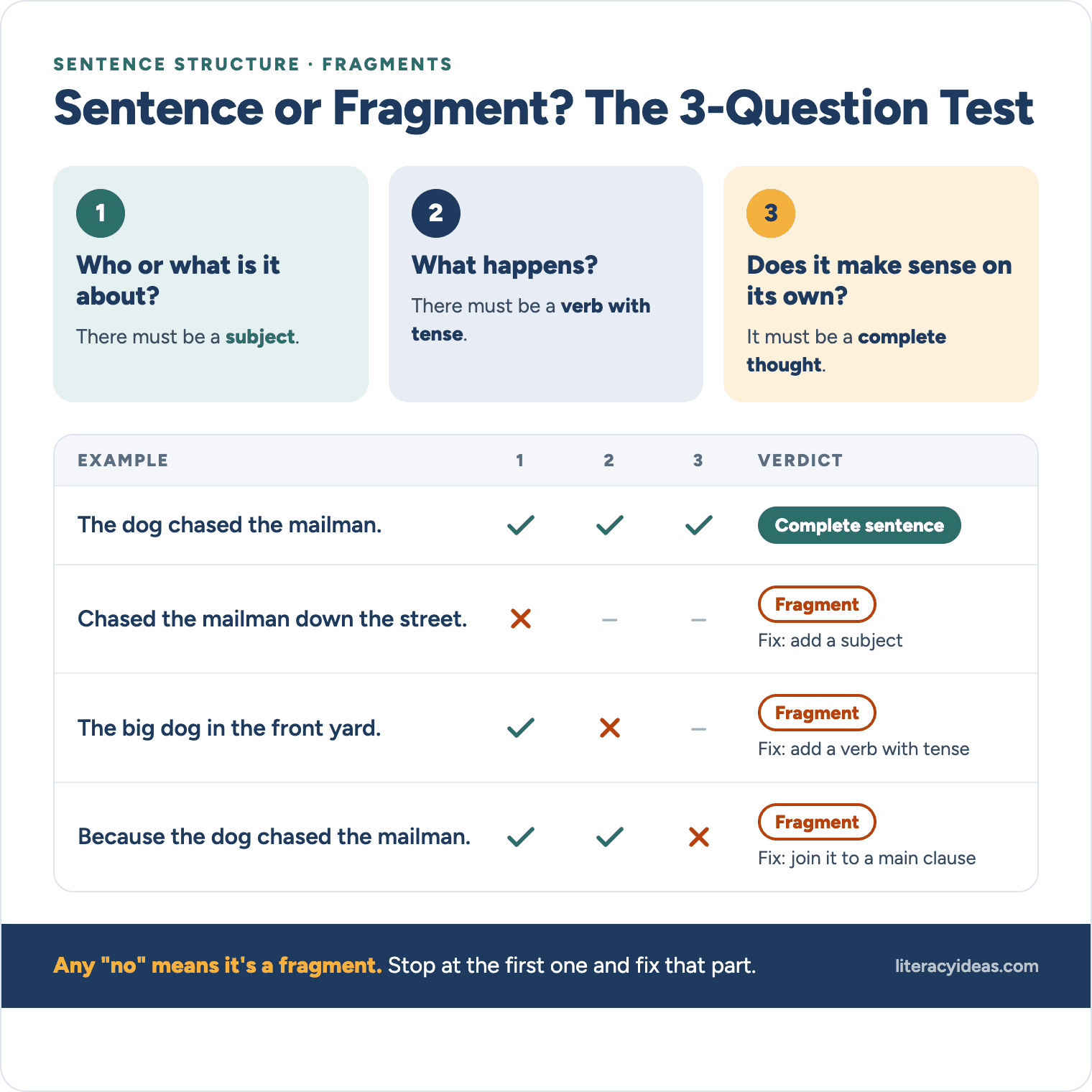
Run the fragment through the three-question test above. The question it fails tells you the fix:
- No subject? Add one. Jumped further than a kangaroo. → The boy jumped further than a kangaroo.
- No verb with tense? Add one, or change the verb form. My favorite math teacher. → My favorite math teacher explains everything twice.
- Doesn’t make sense on its own? It’s usually a dependent clause. Attach it to a main clause. When my mother married my father. → When my mother married my father, they moved to Melbourne.
The third type is the one students miss most, because it has a subject and a verb and looks complete. Teach students to treat any sentence starting with because, when, although, if or since as a warning sign: check whether it has a main clause attached.
A five-day teaching sequence
If you’re planning a sentence structure unit from scratch, this order works because each day builds directly on the one before.
Day 1: Clauses. Teach independent and dependent clauses using the three-question test. Students sort a mixed set of word groups into “sentence” and “fragment.”
Day 2: Simple sentences and fragments. Build simple sentences using subject–verb–object, then fix fragments by finding which part is missing.
Day 3: Compound sentences and run-ons. Introduce FANBOYS and the comma that goes with them. Then show what happens when the conjunction is left out: run-ons and comma splices.
Day 4: Complex sentences. Teach subordinating conjunctions and the comma rule. Students rewrite Day 3’s run-ons as complex sentences and discuss how the meaning shifts.
Day 5: Compound-complex sentences and review. Combine everything. Finish with a short assessment where students identify all four sentence types and write one of each.
This is the sequence my Sentence Structure Unit is built around. It includes the slides, worksheets and assessment for every step, if you’d rather not build them yourself.
Before you publish this, check that the five days line up closely enough with the unit’s actual lessons to make that last line true. I’ve matched it to the unit’s topic list, not to the lesson files.
TOP TIPS FOR TEACHING SENTENCE STRUCTURE
- Start with the basics: Begin by teaching students about the different parts of a sentence, such as subject, verb, and object. Use examples and visual aids to help them understand the function of each part.
- Use varied sentence structures: Show students examples of different sentence structures, such as simple, compound, and complex sentences. Please encourage them to use varied sentence structures in their writing.
- Practice with sentence combining: Give students several short, simple sentences and ask them to combine them into a longer sentence using conjunctions or other connecting words. This exercise will help them understand how to construct complex sentences.
- Use real-life examples: Incorporate examples from everyday life to help students understand how sentence structure affects meaning. For example, “I saw the man with the telescope” and “I saw the man, with the telescope” have different meanings due to the placement of the comma.
- Provide feedback: Give students feedback on their writing, focusing on the structure of their sentences. Encourage them to revise and improve their writing by experimenting with different sentence structures. Please provide specific examples of how they can improve their sentence structure.
SENTENCE STRUCTURE VIDEO TUTORIALS


Need a Complete, No-Prep Solution?
Piecing together grammar lessons, anchor charts and worksheets week by week takes hours you probably don’t have. My Sentence Structure Unit follows the five-day sequence above and gives you everything to teach it tomorrow: interactive Google Slides and PowerPoint lessons, student worksheets, anchor charts, and assessments with rubrics.
“This unit clearly explains simple, compound, and complex sentences. My students understand sentence types much better now!”
— Alana L., TpT review
Get the 5-lesson unit — $4.75 →
SENTENCE STRUCTURE: FREQUENTLY ASKED QUESTIONS
What are the four types of sentence structure?
Simple (one independent clause), compound (two or more independent clauses joined by a coordinating conjunction or semicolon), complex (one independent clause plus at least one dependent clause), and compound-complex (two or more independent clauses plus at least one dependent clause).
What’s the difference between a compound and a complex sentence?
A compound sentence joins two clauses that could each stand alone, usually with a FANBOYS word: I was tired, so I went to bed. A complex sentence joins a clause that can stand alone to one that can’t, using a subordinating conjunction: Because I was tired, I went to bed.
What is the difference between a run-on and a comma splice?
A comma splice is one type of run-on. Any two independent clauses joined without correct punctuation make a run-on. If they’re joined by a comma alone, it’s specifically called a comma splice.
Can a simple sentence be long?
Yes. A simple sentence has one independent clause, but that clause can carry lots of detail: This new research on healthy habits reveals the powerful effect of an active lifestyle on the life expectancy of the average person. is long, but simple.
When do you use a comma in a complex sentence?
When the dependent clause comes first: When the bell rang, we packed our bags. No comma is needed when the independent clause comes first: We packed our bags when the bell rang.
What grade do students learn sentence structure?
In the US Common Core standards, students produce simple, compound and complex sentences in grade 3 (L.3.1i), correct fragments and run-ons in grade 4 (L.4.1f), and choose among all four sentence types to show relationships between ideas in grade 7 (L.7.1b). Most teachers revisit the topic every year from grades 3 to 8 as students’ writing grows more complex.
Please double-check those three standard codes before publishing. I’m confident in them, but they’re the one claim on the page a teacher might hold you to.