Most students love writing stories. Far fewer write good ones.
The gap is rarely imagination. It’s craft. Students need to know that a story needs a problem, that characters are shown rather than described, and that an ending has to resolve something. Narratives draw on every writing skill students already have, then add one more: the ability to spin a good yarn.
This guide is for teachers of grades 3–8, with students aged roughly 8 to 14. It covers how stories are built, how to teach each story element, the problems you’ll see in almost every class set, a four-week teaching sequence and how to assess the finished stories. Annotated student samples and a bank of prompts sit near the end.
What is a Narrative?

A narrative is a story told through a sequence of events, in which characters face a problem and that problem is resolved. It can be invented or based on real events. Its main purpose is usually to entertain, but a narrative can also teach a lesson, build empathy or make the reader think.
You’ll also hear narratives called creative writing, story writing or imaginative writing. Narrative sits alongside persuasive and informative writing as a core text type in almost every English curriculum. Students write stories from their first year of school, and narrative is a staple of standardized writing tests.
Students often confuse narratives with two close relatives. The difference is the problem.
| Text type | What it is | Needs a problem to solve? |
|---|---|---|
| Narrative | An invented or retold story with characters, a conflict and a resolution | Yes. No problem, no story |
| Personal narrative | A true story from the writer’s own life, shaped like a story | Usually, often a small one |
| Recount | A retelling of events in order, to inform or record | No |
Narrative Genres
Narratives come in many genres, and students write more confidently in one they already read and enjoy:
- Adventure and quest
- Fairy tale
- Fable
- Myth and legend
- Fantasy
- Science fiction
- Mystery
- Realistic fiction
- Historical fiction
- Comedy
- Spooky stories and suspense
- Drama and tragedy

Genre changes the setting, the characters and the kind of problem. It doesn’t change the structure. Every genre is built from the same story elements, which is why teaching the elements well pays off across every story a student writes. For a deeper look at reading and analyzing them, see our guide to story elements
How a Narrative Is Structured
Two structure models are taught in most classrooms, and teachers often wonder which one is right. They are the same story described at two levels of detail.
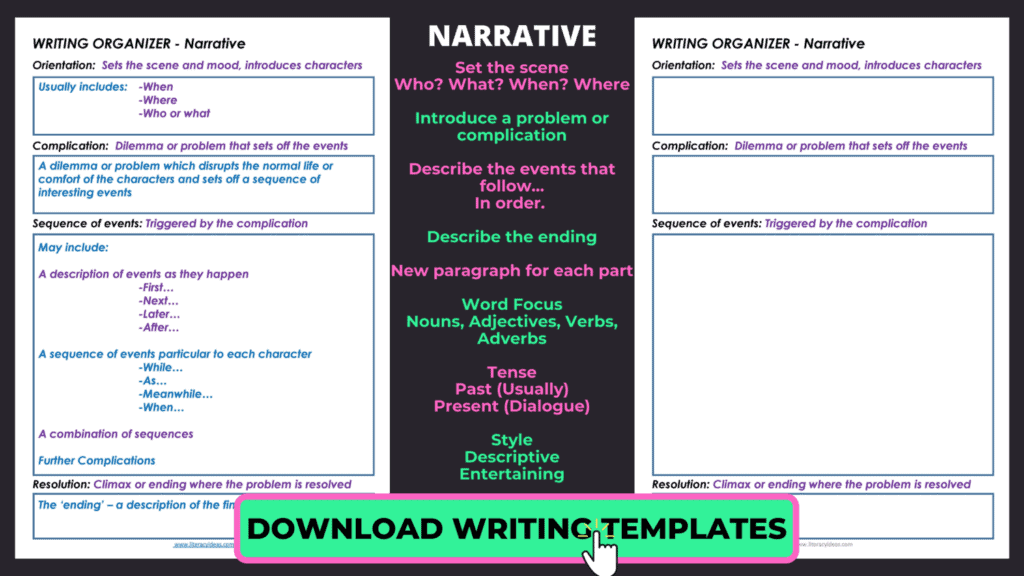
Beginning, middle and end is the simplest model, and the one younger writers should master first. Many teachers call the same three parts orientation, complication and resolution.
The plot map, also called a plot diagram or story mountain, zooms in on the middle. Its five stages (introduction, rising action, climax, falling action, resolution) show students that the middle of a story isn’t one moment but a build-up of tension to a peak.
| Beginning, middle, end | Plot map | What happens |
|---|---|---|
| Beginning | Introduction | Introduces the main character, the setting and the time. Answers who, where and when. |
| Middle | Rising action | A problem appears. Events build on each other, and each makes things harder or tenser. |
| Middle | Climax | The turning point. The character faces the problem head-on and the tension peaks. |
| End | Falling action | The immediate results of the climax play out. |
| End | Resolution | Loose ends are tied up. The reader learns how things settle, happily or not. |
A practical rule: teach beginning, middle and end in grades 3–4, then introduce the plot map from grade 5. When older students learn the plot map, show them the table above. They’ll see that nothing they learned earlier was wrong.
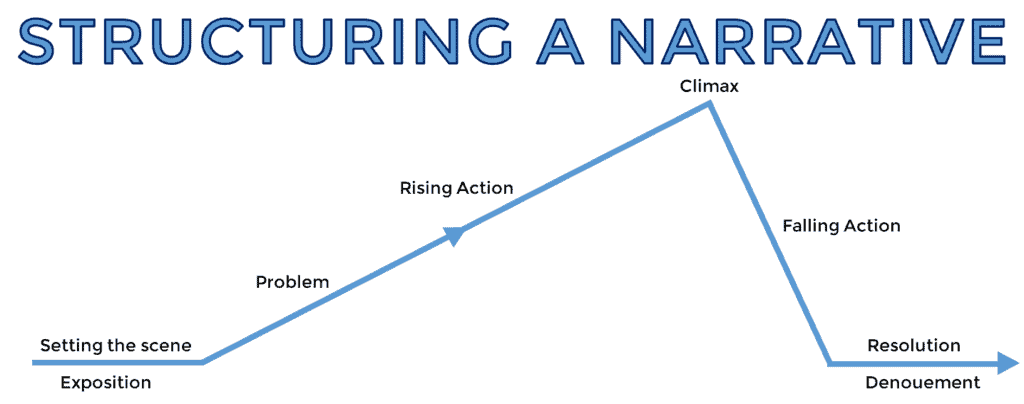
Think of the plot map as a road map for the characters’ journey. It marks the stops along the way and shows how each event builds toward the climax. Have students sketch one before they write, and again after reading a class text. Mapping a story they know makes planning their own much easier.
Plenty of published stories bend this shape, starting at the climax or jumping back in time. That’s a skill for confident writers. Students need to control the standard shape before they break it.
The Five Story Elements
Every narrative is built from five elements:
- Characters: who the story is about
- Setting: where and when it happens
- Plot: the sequence of events
- Conflict: the problem that drives the plot
- Resolution: how the problem is settled
Plot is the thread that runs through conflict, climax and resolution. So this guide teaches it through those stages rather than as a separate lesson.
This video we created provides an excellent overview of these elements and demonstrates them in action in stories we all know and love.
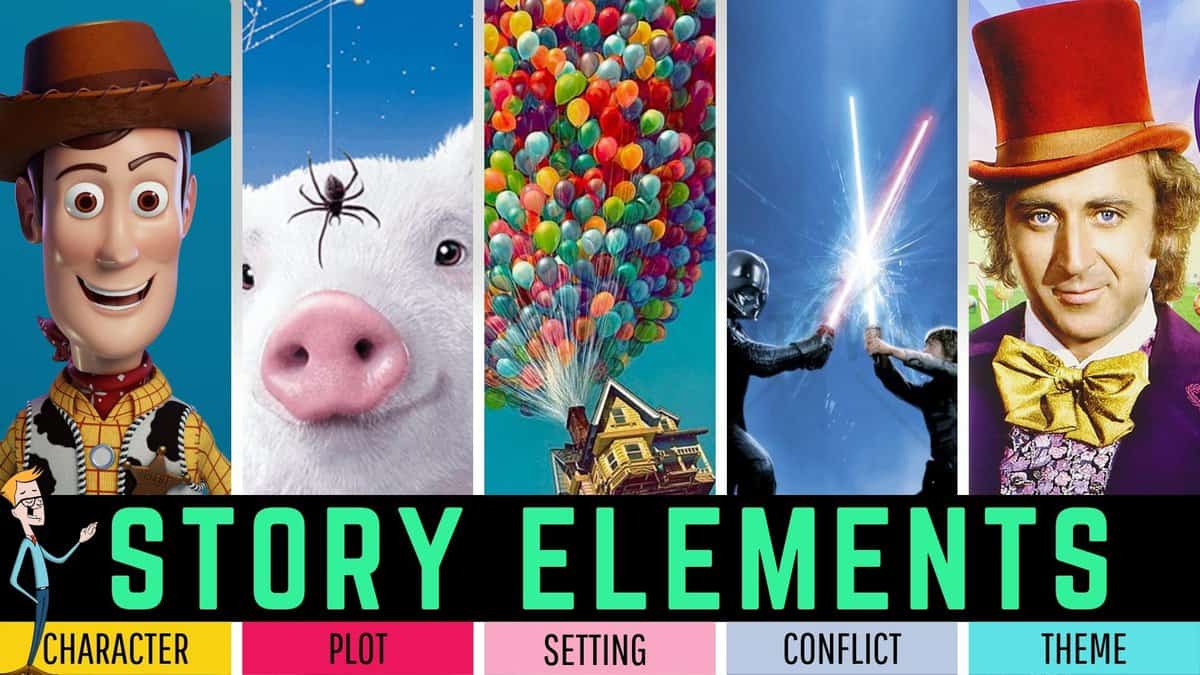
This six-minute video introduces the five elements and shows them at work in stories students already know. It makes a good opening lesson for the unit.
Language Features of a Narrative
Structure gives a story its shape. These features bring it to life:
- Descriptive and figurative language. Sensory detail, strong verbs, similes and metaphors paint pictures in the reader’s mind. See our guide to figurative language.
- Consistent point of view. Most student stories use first person (“I”) or third person (“she”, “they”). Whichever they choose, they should keep it the whole way through.
- Dialogue. Speech reveals character and moves the action. Teach the conventions early: quotation marks, and a new line for each new speaker.
- Past tense. Most narratives are told in the past tense. A flashback or a change of tense must be clearly signaled, or the reader gets lost.
- Paragraphing. A new paragraph marks a change of time, place, speaker or focus. Getting this right makes even a simple story easier to follow.
How to Teach the Story Elements
Teach the elements one at a time, in the order a writer meets them: setting, characters, conflict, climax, resolution. Give each one a model, a short practice task and a chance to apply it to the student’s own story. Then bring them back together.
1. Setting: The Where and the When
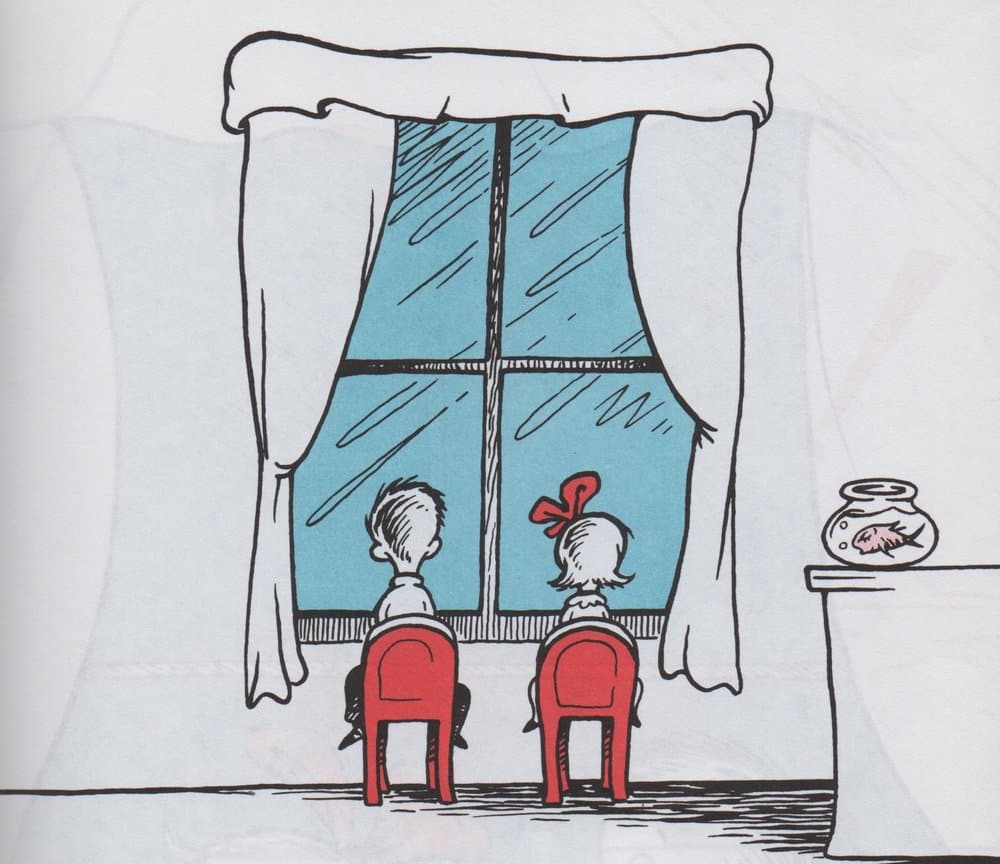
The setting answers two of a story’s central questions: where and when. It also tells the reader what kind of story they’re in.
A horror story opens on a crumbling house on a hill or an abandoned asylum deep in the woods. A rocket hurtling toward Alpha Centauri tells us we’re reading science fiction. These conventions are well-worn clichés. But they’re useful starting points for novice writers, and choosing a setting that fits the genre is a good first exercise for younger students.
Older or more confident writers can play against expectations. A story that opens at a child’s birthday party doesn’t promise horror. The reader relaxes into nostalgia, and that sense of safety makes the shock that follows hit harder.
Make the world believable. At the heart of every story is a bargain. The reader agrees to suspend disbelief, as long as the writer builds a world that feels consistent and real. The surest way to do that is through the senses. Ask students to walk through their setting before they write:
- What does it look like?
- What does it sound like?
- What can you smell as your character moves through it?
- What does the ground feel like underfoot?
- If there’s food, what does it taste like?
Then ask about the when. Is it a gleaming future city, or an overcrowded 16th-century London with waste in the streets? If students can build a multi-sensory picture in the reader’s mind, they’ve done this part of the job well.
Classroom activities for setting
- Class word bank. Write the genre or setting in the middle of the board and collect words and phrases for each sense. Students draw on it while drafting.
- Picture prompts. Give each student an image of a place and have them write one paragraph using three senses. Our visual writing prompts work well here.
- Shared opening line. Give the whole class the same first sentence. The stories will start the same and end in wildly different places, which makes a great discussion.
Common settings in children’s stories include a fairytale kingdom, a magical forest, a school, a village or town, an island, a castle, a jungle, a farm, an underwater world and an alien planet.
2. Characters: The Who
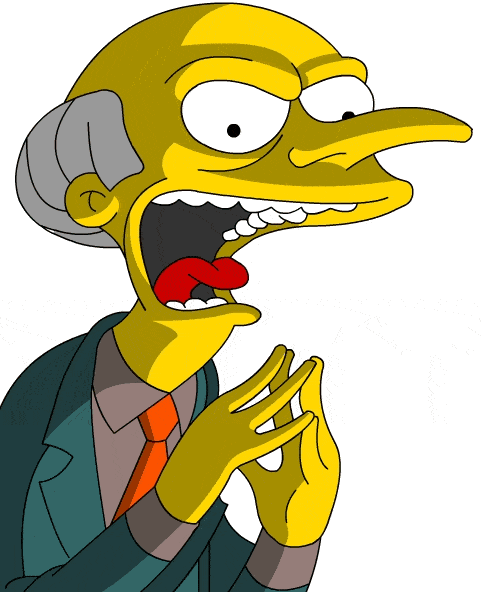
Once students have built a believable world, they need to fill it with believable people.
Keep the cast small. A short story needs one main character and two or three secondary ones at most. Think of it as a small play in a local theater, not a Hollywood blockbuster. Too many characters confuse the reader and overwhelm a young writer. Keep it simple.
Know the character before writing. Students often find characters the hardest element to write. Basing a character on someone they know makes it less daunting. Either way, a short character profile is a valuable prewriting task:
- How do they walk and talk?
- What do they look like? Any distinguishing features?
- What do they want more than anything?
- What are they afraid of?
Small details bring a character to life: a crooked nose, a limp, a habit of humming when nervous. Some students like to find a picture of a face to work from and let their imagination fill in the rest.
Teach show, don’t tell. Young writers tend to tell the reader what a character is like: “Sam was shy.” The leap to better writing comes when they show it instead, through actions, speech and reactions.
- A character who walks with head down and shoulders hunched, avoiding everyone’s eyes, is clearly timid. The word never appears.
- A character who sits down to dinner and starts stuffing roast potatoes into his mouth before anyone else has a plate shows greed.
Watch for adjective stuffing in early drafts: “the big, scary, mean, ugly monster.” Pick one adjective and have the student rewrite the sentence so an action shows it instead.
Classroom activities for characters
- Trait charades. Give students a list of character traits. Each writes a few sentences of a character doing something that reveals one trait, without naming it. Classmates guess the trait.
- Hot seat. A student answers questions in role as their character. Gaps in the profile show up fast.
- Trait and plot. Discuss how traits shape events. A determined character pushes through obstacles. A lazy one may fail, which can be a story too.
Traits that often drive children’s stories include kindness, bravery, curiosity, determination, honesty, loyalty, imagination, compassion, perseverance and responsibility. For more depth, see our guide to writing great characters and settings.
3. Conflict: No Problem, No Story

This is where most young writers struggle, and it’s the element worth the most teaching time.
Students must understand that without a problem, there is no story. The problem drives the action. In a short story, it usually centers on what the main character wants, or doesn’t want, to happen. It’s the hurdle the character must get over, and the story is the struggle to get over it.
A simple test helps students check their plan: What does my character want, and what stands in the way? If a student can’t answer both halves, the story isn’t ready to write.
Even students who include a problem often leave it hanging. In real life, many problems are never solved, and students naturally write what they know. But a story isn’t real life. The problem must be settled one way or another. Whether the character triumphs or is defeated matters less than reaching a clear outcome.
Classroom activities for conflict
- Find the problem. Read familiar fables and fairy tales, such as The Three Little Pigs, The Boy Who Cried Wolf and Cinderella. In each, students name what the character wants and what stops them.
- Raise the stakes. Give students a weak problem (“Mia lost her pencil”) and have groups make it matter more. What if it was the pencil her grandmother gave her, on the day of the big drawing competition?
Stories can have several problems, and heroes often fail on the first attempt. But for developing writers, one clear problem is plenty. They can handle more complex plots as their skills grow.
The six classic types of conflict give students a menu to choose from:
| Conflict type | The character struggles against… | Example |
|---|---|---|
| Character vs character | another person | A bully, a rival, a villain |
| Character vs self | their own fear, doubt or temptation | Finding the courage to speak up |
| Character vs nature | weather, animals, the wilderness | Lost in a storm |
| Character vs society | rules, traditions or a group | Standing up to an unfair law |
| Character vs technology | machines or inventions | A robot that won’t obey |
| Character vs fate or the supernatural | destiny, magic, forces beyond control | A curse that must be broken |
Conflict creates the tension and suspense that keep readers turning pages and make them care about the outcome. It’s also where characters grow and change, which is what makes a story memorable.
4. Climax: Where It All Comes to a Head

The climax is the dramatic high point of the story. The struggle set up by the problem comes to a head, and two opposing forces face off until one wins. This is where the reader learns whether the ending will be happy or sad.
The climax only works if the earlier elements are strong. If the reader cares about a believable character, the climax lands with real emotional force. And the problem must matter deeply to that character. That’s what is at stake.
To help students feel what a climax does, have them talk about their favorite books and films:
- What was the most exciting moment?
- What was at stake for the character?
- What did you feel in your body? Did you breathe faster, grip the cushion, feel your heart pound?
That physical response is what a good climax produces, and what students should aim for in their own writing. A useful craft tip: slow down at the climax. Students tend to rush the most important moment. Short sentences, sensory detail and the character’s thoughts stretch it out and build suspense.
Common climaxes in children’s stories:
- A showdown between good and evil
- The character’s bravery saves the day
- The character faces and overcomes a fear
- The character solves the mystery or puzzle
- The character stands up for what’s right
- The character makes a difficult choice or a selfless sacrifice
5. Resolution: Tying Up Loose Ends
After the climax, a few questions remain even though the main conflict is settled. The resolution answers them. In a short story it may be only a paragraph or two, but it’s needed. Ending straight after the climax feels abrupt and leaves the reader unsatisfied.
The traditional fairy tale ending is the easiest way to explain this: “And they all lived happily ever after.” It’s a forecast for the future that gives the reader closure and lets them say goodbye. Ask students what feeling they want to leave the reader with, then write toward it.
The resolution is also where a twist can appear. Picture a story that ends by revealing the narrator was the family dog all along. Twists are hard to do well, because the clues must be there from the start. They make a good extension challenge for confident writers.
One ending to rule out early: “…and then I woke up. It was all a dream.” It cancels the whole story. The best resolutions come from the character’s own choices at the climax.
Common resolutions in children’s stories:
- The hero reaches their goal
- The character learns a valuable lesson
- The character changes for the better
- The character reunites with loved ones or makes amends
- Balance is restored to the world
- The character learns to appreciate what they already have
From Plan to Final Draft
Knowing the elements is half the job. The other half is a writing routine that gets students from a blank page to a finished story without stalling.
Plan Before Writing
Have students spend roughly the first fifth of their writing time planning. A clear plan keeps the draft focused and stops the story wandering. Reluctant or less confident writers benefit most.
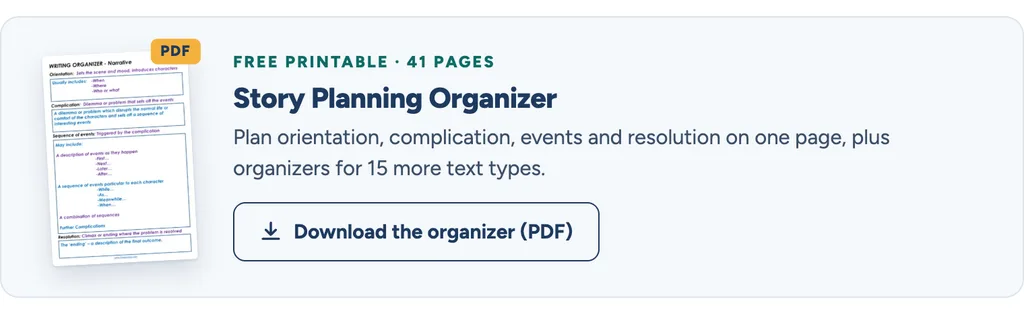
A simple story organizer does the job. Students note the character, setting, problem, three key events, climax and resolution before writing a word. More planning tools are in our guide to graphic organizers.
Model It First
Students write better stories when they’ve watched one being built. A gradual release routine works well for each element:
- I do. Write a short passage live in front of the class, thinking aloud. “I want you to know my character is nervous, but I won’t say nervous. What could she do with her hands?”
- We do. Write the next part together, with students suggesting and you shaping.
- You do. Students apply the same move to their own story.
Back this up with mentor texts. A good picture book is short enough to read in one sitting and rich enough to study. Use it at every grade, including middle school. Choose one that does the element you’re teaching especially well, and read it as writers: “How did the author make us worried for this character?”
Draft Without Stopping
While drafting, students should keep writing and leave corrections for later. If spelling and punctuation are pushed too early, many students freeze and the story never arrives. Call it storytelling paralysis. Give them permission to make mistakes now and fix them later.
Support tools help students keep moving:
- Word banks
- Writing frames and sentence starters
- Mind maps
- Visual and written prompts
Revise, Then Edit
Teach revising and editing as two separate jobs, in that order.
Revising improves the story. Students reread and ask three questions:
- Structure: Does it make sense and flow from beginning to end?
- Story: Is there a clear problem, a real climax and a resolution that settles it?
- Characters: Are they believable, and shown through what they do and say?
Editing fixes the surface: spelling, punctuation, grammar and paragraphing. Our guide to proofreading and editing has strategies for both. Weaker sentence control often shows up here. Our guides to sentence structure and paragraphs can help.
A checklist turns both jobs into something students can do independently, and makes peer conferencing far more useful.
Ten Tips for a Great Narrative (Share with Students)
These work well as a classroom poster or a checklist for revising.
- Know your message. Decide what your story is really about before you start.
- Hook the reader early. Open with action, a question or a striking image.
- Make characters different from each other. Give each one their own personality and way of speaking.
- Set the scene quickly. Let the reader see where and when the story happens before the action gets going.
- Show, don’t tell. Reveal feelings through actions, thoughts and dialogue.
- Use your senses. Describe what can be seen, heard, smelled, felt and tasted.
- Build tension. Use your plot map. Let each event make things harder for your character.
- Slow down at the climax. It’s the most important moment, so don’t rush it.
- End on purpose. Settle the problem and leave the reader with a feeling. No “it was all a dream”.
- Revise, then edit. Fix the story first and the spelling second.
Common Problems in Student Narratives (and How to Fix Them)
Grade any class set of stories and the same eight problems turn up. Each has a quick, teachable fix.
| Problem | What it looks like | The fix |
|---|---|---|
| The “and then” story | A string of events — “and then… and then… and then…” — with nothing building | Map it on the plot map. Cut to three key events, each harder than the last, one per paragraph. |
| No real problem | The character goes somewhere and does things, but nothing goes wrong | Apply the test: what does the character want, and what stands in the way? No answer, no story yet. |
| Too many characters | A crowd of names the reader can’t keep track of | One main character, two or three others at most. Merge or cut the rest. |
| Telling, not showing | “She was sad.” “He was very angry.” Strings of stacked adjectives | Use the Show, Don’t Tell mat. Rewrite the sentence so an action reveals the feeling. |
| The rushed ending | A long build-up, then the problem vanishes in one line | Plan the climax and resolution before drafting. Slow down at the climax. |
| “It was all a dream” | The story is cancelled in the last line | Rule it out. The resolution must come from the character’s own choice or action. |
| Blank-page freeze | Ten minutes in, two lines on the page | Start in the middle of the action. Offer a prompt, a word bank or a shared opening line. |
| Wall of dialogue | Pages of chat with no description and every speaker on one line | New speaker, new line. Each line of dialogue must move the plot or show character. |
Tense drift is a common ninth problem, where a story slides between past and present. Have students decide on a tense before they start. During editing, they highlight every verb to check it.
You don’t need to fix all of these at once. Pick the one or two that most of the class share, teach a mini-lesson on each, and make them the focus of the next draft.
A Four-Week Narrative Writing Unit Plan
Four weeks of four or five lessons is enough to take a class from reading stories to publishing their own. Each week ends with a piece of writing, so you can check understanding before moving on.
| Week | Focus | Key lessons | Students produce |
|---|---|---|---|
| 1 | Reading like a writer | What a narrative is; genres; the five story elements (video); structure and the plot map; finding the problem in fables and fairy tales | A plot map of a class mentor text |
| 2 | Setting and characters | Choosing a setting to suit the genre; writing with the senses; character profiles; show, don’t tell; trait charades | A setting paragraph and a character profile for their own story |
| 3 | Conflict, climax and resolution | Want plus obstacle; raising the stakes; planning with the organizer; slowing down the climax; endings that come from a choice | A completed story plan |
| 4 | Drafting, revising and publishing | Teacher modelling; drafting without stopping; revising with a checklist; peer conferencing; editing; publishing and sharing | A final story and a self-assessment |
Adjusting for your class
- Grades 3–4: Stretch the plan to five or six weeks. Use beginning, middle and end, write as a class first, and keep stories to a page or two.
- Grades 5–6: Run it as written, using the plot map from week 1.
- Grades 7–8: Move faster through weeks 1 and 2. Add lessons on point of view, flashbacks and starting in the middle of the action.
Throughout the unit, weave in the mini-lessons from the common problems table above as they show up in students’ writing.
A COMPLETE UNIT ON TEACHING NARRATIVE WRITING
Teach your students to become skilled story writers with this HUGE NARRATIVE & CREATIVE STORY WRITING UNIT. Offering a COMPLETE SOLUTION to teaching students how to craft CREATIVE CHARACTERS, SUPERB SETTINGS, and PERFECT PLOTS.
Over 209 PAGES of materials, including:
How to Assess Narrative Writing
Assess against a small number of clear criteria, shared with students before they start writing. A rubric that tries to measure everything at once tells a student very little about what to do next.
What Good Looks Like by Grade Band
These expectations reflect what most English curricula ask of narrative writers at each stage.
| Grade band | A strong narrative at this level… |
|---|---|
| Grades 3–4 | Introduces the narrator or characters and the situation. Tells events in a clear order using time words (first, later, suddenly). Uses dialogue and description to show how characters feel. Ends with a clear sense of closure. |
| Grades 5–6 | Does all of the above, with control of pacing. Uses varied transitions and precise, sensory language. The ending follows logically from the events. |
| Grades 7–8 | Establishes and holds a point of view. Signals shifts in time and setting clearly. Uses reflection, varied sentence structures and deliberate word choice to build mood and meaning. |
Whatever rubric your school uses, narratives are usually judged on the same core qualities: ideas, structure, character and setting, voice, word choice, sentence fluency, paragraphing and conventions. Give voice and word choice real weight. That’s where stories come alive.
Practical Assessment Tips
- Focus each draft. Assess the element you’ve just taught, such as character in week 2, rather than everything.
- Conference with a rubric. A two-minute conference against two or three criteria does more than a page of written comments.
- Use samples to calibrate. Compare student work with the samples below before you mark. It keeps judgments consistent across the class and across classes.
- Let students assess first. A self-assessment against the checklist before handing in makes students reread their own work, and they’ll fix much of it themselves.
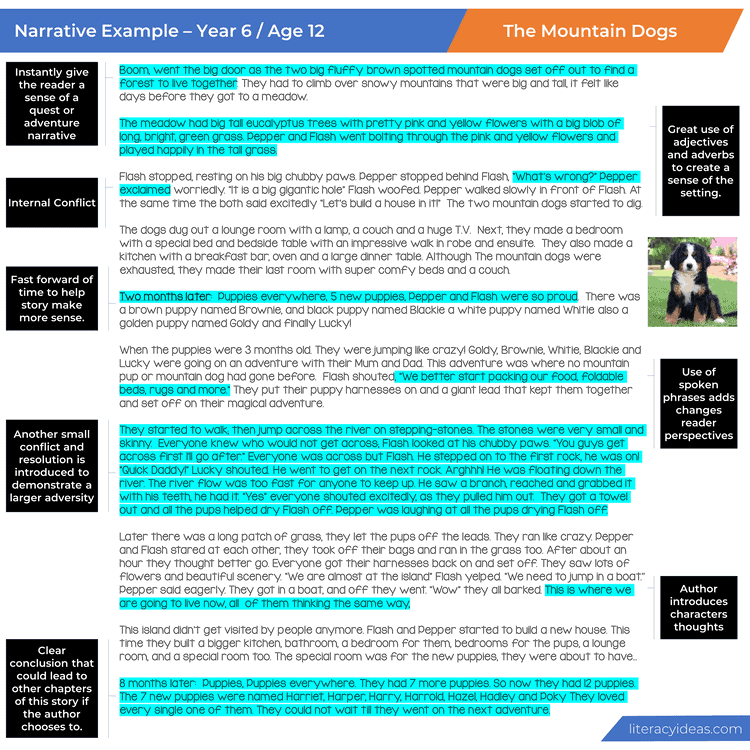
Narrative Writing Examples (Student Samples)
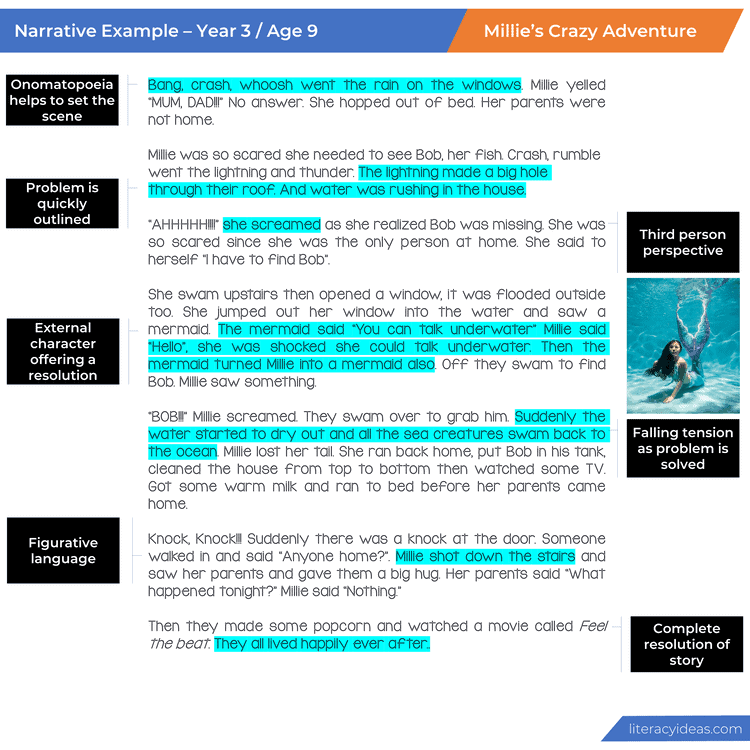
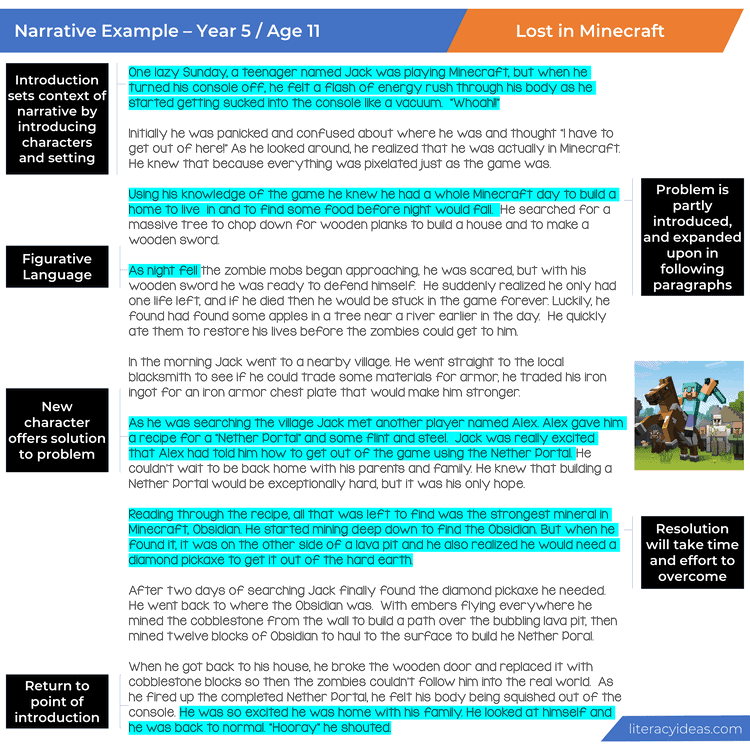
These annotated narratives were written by real students in grades 3–8. Click any image to enlarge it.
They aren’t meant to be perfect models. They’re pieces to study critically with your class: what works, what could be stronger and which story elements each writer handled well. Read the sample for your grade alongside the ones a year above and below. The comparison shows students what the next step looks like.



Narrative Writing Prompts
A strong prompt removes the blank-page problem and gives students a problem to solve from the first line. Use these as they are, or adapt them for your class. You’ll find hundreds more, including visual prompts, in our writing prompts collection.
- The night at Castle Frankenfurter (grades 4–8): Your class trip is booked into a vast, mysterious castle for one night. As darkness falls, its hundred rooms creak and groan, and strange things begin to happen. Who, or what, else is staying the night?
- The explorer’s log (grades 3–6): You’re a famous explorer discovering a new land. Keep a travel log of your adventures. Make sure your entries tell one story, with a clear problem and resolution.
- The invention (grades 5–8): You’ve built an invention that could change the world. Then you notice problems you didn’t plan for, and you may not be able to control it. Tell the story of your creation’s highs and lows.
- Locked in the mall (grades 3–6): The last door of the Megamall slams shut. You and your best friend have the whole shopping center to yourselves until 7 a.m. What adventures await? What goes wrong? And how will you get out without being caught?
- The stranger (grades 6–8): A stranger walks into town. They look like everyone else, but you sense they’re from another time or place. Friend or foe? Suddenly, they walk straight toward you, hand outstretched, as if they can read your mind.
Narrative Writing Video Tutorial

This tutorial walks through planning and writing a narrative from start to finish. It works well as a refresher before students begin their final drafts.
Narrative Writing FAQ
What are the five elements of a narrative? Characters, setting, plot, conflict and resolution. Every story, from a fable to a novel, is built from these five.
What is the structure of a narrative? The simplest structure is beginning, middle and end (also called orientation, complication and resolution). The plot map breaks the same story into five stages: introduction, rising action, climax, falling action and resolution.
What is the difference between a narrative and a recount? A recount retells events in order, to inform. A narrative is built around a problem that builds to a climax and is resolved, usually to entertain.
How long should a student narrative be? Quality matters more than length. As a rough guide, expect one or two pages in grades 3–4 and two to four pages by grades 7–8. A short story with a clear problem and a satisfying ending beats a long one that wanders.
What grade do students learn narrative writing? Students tell stories from their first year of school. Narrative writing is taught in every year of school, in English curricula around the world. The skills grow more sophisticated each year.
How do you teach show, don’t tell? Take a sentence that names a feeling, such as “Tom was scared.” Ask students what a scared person does, says and feels in their body. Then rewrite: “Tom’s hands shook as he reached for the door handle.” The free Show, Don’t Tell mat above gives students a bank of examples to draw on.